

Day 14: Supporting Choice: Alternatives to Guardianship
# Disability
# Equity
21-Day Disability Equity Challenge
October 20, 2026Learn More:
Read:
- Marie Bergum, ACLU - It Took Me 12 Years to Get Out of My Conservatorship. Now I’m Finally Free.
- Jonathan Gardner & Sarah Boonin, WBUR - I’m an Adult with Autism. I Built a Team to Help Me Make Decisions.
- Michigan Department of Health and Human Services – Introduction to Supported Decision-Making Toolkit
Watch:
- The Arc Michigan – Rethinking Guardianship: Supported Decision-Making (18:12, includes captions)
- Paving the Way to Self-Determination, Disability Network Southwest Michigan – Supported Decision-Making (1:19:10, includes captions and transcript)
- Heather Catallo, WXYZ – Michigan Woman Makes History in Guardianship Case, Advocates for Alternative Option (5:26, includes captions and transcript)
Listen:
- Possibilities Podcast, Michigan Developmental Disabilities Institute – Episode 10: Supported Decision-Making (21:23, includes captions, Transcript )
Discussion:
- Everyone makes mistakes while learning and growing. How might not having the opportunity to make mistakes impact disabled people’s development?
- What did you learn today that challenged or changed the way you think about guardianship or decision-making?
- Why is it important for people with disabilities to have a say in decisions about their own lives?
Image:
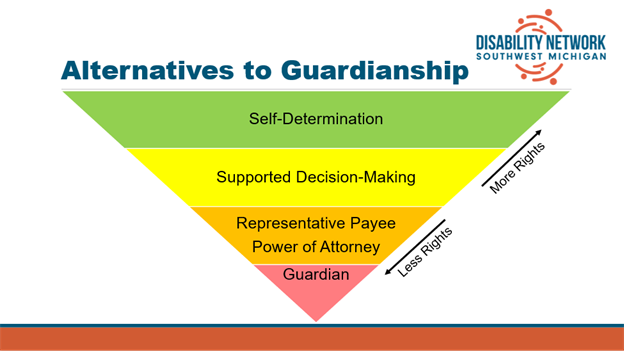
[Image description: Inverted pyramid chart titled “Alternatives to Guardianship,” with four sections. An arrow points up along the inverted pyramid, indicating that a person has “more rights” moving toward the top. An arrow points down along the inverted pyramid, indicating that a person has “less rights” moving toward the bottom. The sections from top to bottom are:
1. Green section that says, “Self-Determination.”
2. Yellow section that says, “Supported Decision-Making.”
3. Orange section that says, “Representative Payee” and “Power of Attorney.”
4. Red section that says, “Guardian.”
Disability Network Southwest Michigan blue and orange logo in upper right corner of the image.
________________________________________________________________________________________________________________
One of the core principles of disability rights is self-determination. Self-determination means people have the right to make choices about their own lives, even if they need support to do so. Like everyone else, people with disabilities want to decide where they live, who they spend time with, how they manage their money, and what goals they want to pursue. Needing support to make decisions does not mean someone should lose the right to make them. People with disabilities have the same rights as anyone else to direct their own lives, make choices and learn from their experiences.
Approximately 1.3 million adults in the United States have guardians appointed to make decisions on their behalf. Guardianship is also known as conservatorship in some states. It’s the legal process by which an individual assumes the role of decision maker for an adult with a disability through a court order.
Guardianship is a legal tool that significantly restricts a disabled person’s rights, independence, and ability to make important life decisions for themselves. Disabled adults under guardianship may not be able to have access to their own finances, live independently, choose to form relationships or get married, or make their own decisions about medical care. Because guardianship can take away important rights and choices, it should be considered only after less restrictive options have been explored.
Families of children with intellectual or developmental disabilities are frequently advised to seek guardianship as their child is about to turn 18. Having an intellectual or developmental disability does not automatically mean a person cannot make their own decisions. Some people may need support to understand information, consider their options, or communicate their choices. Guardianship is often presented as the only option or natural “next step,” leaving many well-meaning families unaware about other ways to support their disabled adult family member, such as supported decision-making .
Supported decision-making allows a person to choose trusted people to help them understand information, consider their options, and communicate their decisions while keeping control over their own choices. This allows people to get the support they need without giving up their legal rights or the ability to make their own decisions.
A good starting point, rather than seeking guardianship, is to try supported decision-making , which allows adults with disabilities to keep their legal rights and make their own decisions, with support from family, friends, and caregivers. Supported decision- making can also include preparing for the future by completing an advance directive or living will . Other alternatives to guardianship that may restrict certain types of decision-making, but not all legal rights, include arranging a durable Power of Attorney , assigning a Representative Payee , setting up a trust , and opening a MiABLE account.
The process and criteria for establishing a guardianship or conservatorship vary by jurisdiction, but it often requires medical or psychological evaluation to determine the disabled individual’s capacity. It is important to remember that medical professionals and court personnel are influenced by the same ableism that pervades our society, which teaches us to underestimate people with disabilities. Establishing guardianship can be a lengthy and invasive process for a disabled person and their family. In addition, the appointment of a guardian can be challenged in court by the person under guardianship or other interested parties, which can lead to legal battles that are both costly and emotionally taxing.
It is also important to remember that everyone has the right to make mistakes, learn from experiences, and make choices others may not agree with. People without disabilities are given that opportunity every day. People with disabilities deserve the same opportunity.
Removing a person’s legal right to make their own decisions should be the last option, not the first. Starting with the belief that disabled people can direct their own lives with the right supports allows adults with disabilities, families and caregivers to make the best choice together. This approach protects the rights of people with disabilities while promoting their dignity, well-being, and independence.
Take Action:
Think about a decision you made recently. You may have asked friends, family, or coworkers for advice, but the final decision was still yours. People with disabilities deserve the same opportunity. This week, pay attention to how decisions are made around you. When someone needs support, consider how you can help them understand their options and make their own decisions. Supporting choice helps build confidence, independence, and self-determination.
Comments (2)
Popular

Dive in
Related
External Content
"I'm Going to Take Care of You": A Day at a Free Tax Prep Site in Lansing
May 19th, 2026 • Views 1
External Content
"I'm Going to Take Care of You": A Day at a Free Tax Prep Site in Lansing
May 19th, 2026 • Views 1