
equity
October 6, 2026
Day 4: Understanding Hidden Disabilities
# Challenge
# Disability
# Equity
21-Day Disability Equity Challenge
TODAY'S CHALLENGE TOPIC: Hidden Disabilities
Note: If you've not yet read today's intro, please find it at the bottom of this post.
Read:
- Hidden Disabilities Sunflower – Skin-Deep: Not All Disabilities Are Visible
- Invisible Disabilities Association – What Is an Invisible Disability?
- Online Learning Consortium – Seeing the Unseen: Raising Awareness of Invisible Disabilities
- Understood – Understanding Learning and Thinking Differences
Watch:
- Amber Hammond, TEDx Nicolet College – Invisible Disabilities (10:13, includes captions and transcript)
- PBS Vitals – How Adult ADHD Goes Undetected (13:55, includes captions and transcript)
- PBS News Hour – Actor and Writer Henry Winkler on His Dyslexia (9:14, includes captions and transcript)
Listen:
- Understood Podcast – ADHD Aha! Personal Stories (Series, includes transcripts for each episode)
- Divergent Conversations Podcast – Autistic Masking: Mental Health, Identity, Safety & Privilege (50:44, includes transcript)
Discussion:
- Think of a time when you were questioned or not believed. How did it feel?
- How might having to explain or prove a disability over and over again affect a person’s mental health?
- What is an assumption about hidden disability that you want to learn more about or change after today?
- Visit our Day 4 Discussion post to share any thoughts, insights or questions.
Image:
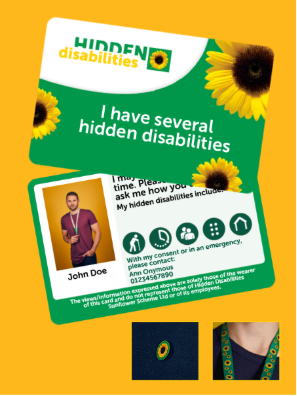
[Image description: Hidden Disabilities Sunflower ID Cards. The front of a customized card says, “I have several hidden disabilities.” The back of the personalized card features a placeholder photo of a man with the name John Doe, space for personal medical details, icons highlighting access needs, and an emergency contact field. A pin and lanyard with a green background and sunflower icons appear below.
Community Conversation
Please join us for one of two virtual community conversations facilitated by Disability Network Southwest Michigan, offering the opportunity to connect with others taking the challenge and gain deeper learning from experts in the field.
Register today:
___________________________________________________________________________________________
Hidden Disabilities - Looking Beyond What You Can See
Not every disability is visible. When many people think of disability, they picture someone using a wheelchair, white cane, service animal, or other visible support. While those disabilities certainly exist, it’s estimated that 70 to 80% of disabilities are not visible. These are often called hidden, invisible, non-visible, or non-apparent disabilities.
A hidden disability is a physical, mental, neurological, learning, sensory, or chronic health condition that may not be immediately obvious to others but still affects a person's daily life.
Hidden disabilities include conditions like chronic pain, migraine, epilepsy, learning disabilities, ADHD, autism, anxiety disorders, depression, PTSD, autoimmune diseases, hearing loss, low vision, and many others. Every person's experience is unique, and symptoms may change from day to day.
One of the biggest challenges people with hidden disabilities face is that others often don't believe them. Because there are no obvious signs, people may hear comments like:
- "You don't look disabled."
- "You're too young to have that."
- "Everyone gets anxious."
- "You were fine yesterday."
These assumptions can be harmful to the individual. Many people spend significant emotional energy explaining, defending, or even hiding their disability to avoid judgment.
Living with a hidden disability often means balancing symptoms that others cannot see. Someone may be managing chronic pain while working a full shift, experiencing brain fog during a meeting, changing how they would normally act in public so people will not know they are autistic, or coping with anxiety while appearing calm on the outside. The effort to "look okay" can be exhausting.
Hidden disabilities can also affect relationships, education, employment, and healthcare. Students may struggle to keep up without appropriate supports. Employees may avoid requesting accommodations because they fear discrimination. Patients may have their symptoms dismissed because they don't "appear sick." This is why listening matters.
We don’t have to fully understand someone’s disability to respect their experience. When someone tells us what they need, believing them is one of the simplest and most meaningful forms of inclusion.
Creating a more inclusive community doesn’t require knowing about everyone’s disability. Instead, we can:
- Challenge assumptions about what disability looks like.
- Respect people’s privacy and remember that disclosure is a personal choice.
- Offer flexibility whenever possible.
- Create welcoming spaces that consider sensory needs and accessibility.
- Believe people when they tell you about their lived experiences.
Hidden disabilities remind us that we cannot judge another person’s experience by what we can see. By choosing curiosity over assumptions, empathy over judgment, and listening to people's lived experiences, we can create communities where everyone feels valued, respected, and included. After all, accessibility isn't just about removing physical barriers, it's also about removing the attitudes and assumptions that prevent people from fully belonging.
Take Action:
Learn to recognize and respect tools people may use to signal a hidden disability, such as the Hidden Disabilities Sunflower lanyard, which lets someone choose to share that they may need extra time, patience, or support. One way to put this into practice is to train staff and volunteers to respond to these signals by understanding, not demanding personal explanations, and offering help in a calm, respectful way. This helps reduce pressure on people to give out personal information while still making support visible and accessible.
Comments (2)
Popular

Dive in