equity
October 2, 2026
Day 2: Disability Language
# Equity
# Disability
# Challenge
21-Day Disability Equity Challenge
TODAY'S CHALLENGE TOPIC: Disability Language
Note: If you've not yet read today's intro, please find it at the bottom of this post. If you missed Day 1, you can find it here.
Read
- Alaina Leary, Rooted in Rights – If You’re Writing About Disability, You Need to Read These Guidelines
- Lawrence Carter-Long, The Viscardi Center – DISABLED. #SayTheWord Went Viral 10 Years Ago: What It Revealed, What I’ve Learned, and What Still Needs Work
- CommunicationFIRST – The Words We Use Style Guide
- Nick Walker, PhD – Neurodiversity: Some Basic Terms and Definitions
Watch
- Disability Network Southwest Michigan – #DWord: Disability Is Not a Bad Word (2:16, includes captions and transcript)
- Conversations with Ivanova – Conversations with Ivanova: People First and Identity First Language (3:08, includes captions and transcript)
- Annie Elainey – Disabled Person or Person with a Disability? (7:03, includes captions and transcript)
- Remy W. Anders – Autism Language Guide (5:21, includes captions and transcript)
Listen
- It’s Been a Minute Podcast, NPR – The Worrisome Return of the R-Word (15:00)
- Think Inclusive Podcast – Disability Language: Insights from Lachi's Journey (59:58, includes transcript, Captioned Video )
- Down to the Struts Podcast – Episode 2: The Language of Disability with Dr. Sara Acevedo (36:17, Transcript )
Discussion
- Think about how you talk about disabled people. What is one change you can make to talk about disability in a more neutral way?
- Think about the people with disabilities that you know. How do they talk about their disabilities? Why might that be?
- Think about the definition provided for the word “neurodivergent.” What disabilities are included in this definition that you didn’t recognize as a form of neurodivergence before?
- Visit our Day 2 Discussion Post to share any thoughts, insights or questions.
Image
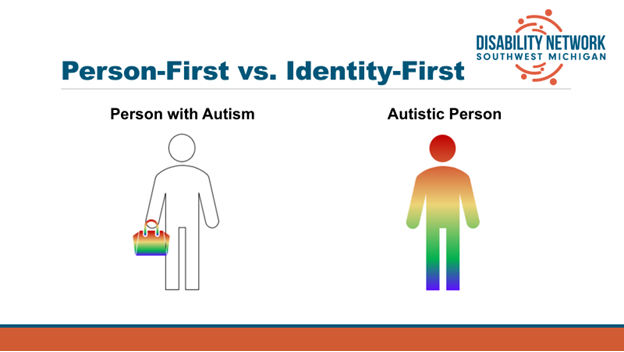
[Image description: An illustration titled “Person-First vs. Identity-First,” referring to different ways of using respectful disability language. On the left is a person holding a rainbow-colored bag, labeled “person with autism.” On the right is a person with a rainbow-colored body, labeled “Autistic person.” Disability Network Southwest Michigan blue and orange logo in upper right corner of the image.
Community Conversation
Please join us for one of two virtual community conversations facilitated by Disability Network Southwest Michigan, offering the opportunity to connect with others taking the challenge and gain deeper learning from experts in the field.
Register today:
___________________________________________________________________________________________
Disability Language
The language we use is powerful. The words we choose to describe things reflect our values. Unfortunately, much of the language used around disability portrays it as a negative thing—something that is “sad” or “bad,” that must be “overcome,” or with which someone is “afflicted.” We do not have to talk about disability this way! If we think of disability as a natural part of human diversity, then we can use neutral and non-judgmental language to discuss disability.
The word “disability” is the preferred term within the disability community, and it is the word used to protect disabled people’s civil rights in laws like the Americans with Disabilities Act. Many people with disabilities consider terms such as “handicapped,” “differently abled,” and “special needs” outdated, dismissive, and harmful. Disability is not a bad word, and avoiding the word perpetuates shame and stigma surrounding disability. “Disabled” is an adjective to describe people, not a noun to be left on its own. Instead of “the disabled,” we can say “the disabled community” or “disabled people.”
Many of the words used around disability have developed negative connotations or come from an insulting view of disabled people. Even when you do not intend to talk directly about disability, using words associated with disability as insults contributes to bias and can hurt people with disabilities. To create more inclusive environments, avoid using offensive terms like “lame,” “idiot,” “psycho,” “dumb,” and the R-slur in casual speech. Although some disabled people have reclaimed terms like “crip” or “mad” to describe their disability identity, others should not use these terms to talk about a disabled person unless the person asks them to do so.
When talking to or about a person with a disability, frame the conversation around how they do things rather than what they “can’t” do. Consider these two sentences: “Ash is nonverbal,” vs. “Ash uses an app on a tablet to talk.” Which of these sounds more neutral? Which provides the most useful information about Ash’s needs? Additionally, many nonspeaking people who use assistive technology to communicate dislike the term “nonverbal” because “verbal” means “relating to words or language.”
When talking about people with disabilities, there are two main approaches: “person-first” and “identity-first” language. The person-first approach puts the person before the disability (“I am a woman with dyslexia.”), while identity-first puts the disability first (“I am a dyslexic woman.”). Neither is wrong, and both are used within the disability community. Some people with disabilities are still fighting to be seen as whole people and prefer person-first language, including many people with intellectual and developmental disabilities. Other disabled people feel their disability is a core part of who they are and prefer identity-first language, including many Deaf and Autistic people.
Identity-first language is especially popular among those who identify as neurodivergent. “Neurodivergent” means having a brain or mind that differs significantly from neuronormativity, which is the way society expects a brain “should” work. Some people are born neurodivergent, and many people acquire neurodivergence during their lifetime. The best way to know which language a person prefers is to ask them or to listen to how they talk about their disability.
Take Action:
Biased disability language is deeply embedded in our culture, but each conversation you have about disability is an opportunity to lead by example. Consistently demonstrating the use of neutral, non-judgmental disability language can shift perceptions and positively influence those around you. If you make a mistake, it’s ok to acknowledge that and correct yourself. If someone else uses inappropriate terms, you can gently educate them by offering alternative phrasing, explaining the impact of their words, and sharing resources with those who are open to learning more. Cultural change takes time and energy, so be patient, choose your battles wisely, and express appreciation when people get it right.
Comment (1)
Popular

Dive in