
equity
October 5, 2026
Day 3: Models of Disability
# Disability
# Equity
21-Day Disability Equity Challenge
TODAY'S CHALLENGE TOPIC: Models of Disability
Note: If you've not yet read today's intro, please find it at the bottom of this post. If you missed Day 2, you can find it here.
Read
- AutisticTic – Introducing the Holistic Model of Disability
- Kassiane Asasumasu, Autistic Self Advocacy Network – Acceptance vs. Awareness
Watch
- Sins Invalid & Barnard Center for Research on Women – My Body Doesn't Oppress Me, Society Does (5:08, includes captions and transcript)
- Scope – What Is the Social Model of Disability? (3:07, includes captions and transcript)
Listen
- Short Wave Podcast, NPR – The Social Side of Stuttering (16:20, includes transcript)
Discussion
- How do the different models of disability show up in your day-to-day life? How might they impact people with disabilities?
- When you encounter people with disabilities, what feelings or thoughts come to mind? Do these feelings or thoughts reflect the medical, social or holistic models of disability?
- What barriers in your community prevent the inclusion of people with disabilities?
- Visit our Day 3 Discussion Post to share any thoughts, insights or questions.
Image
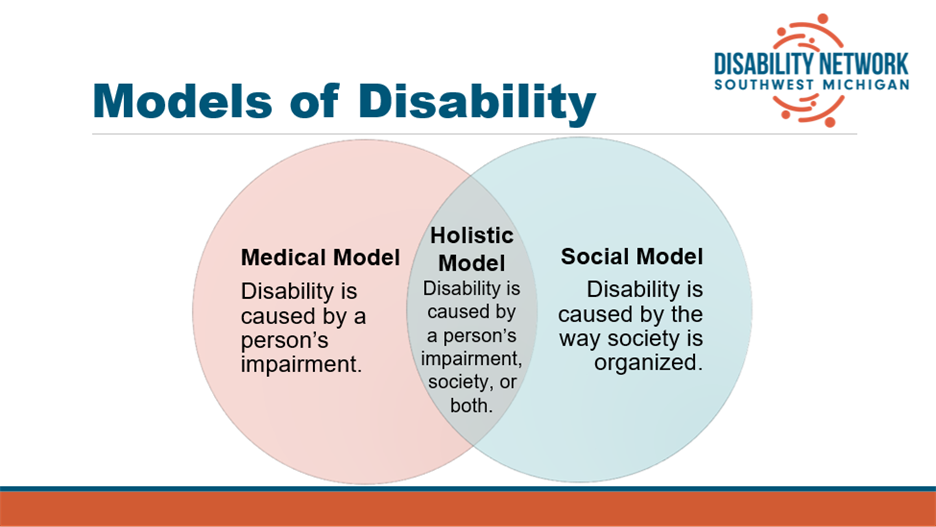
[Image description: A Venn diagram titled “Models of Disability” with two overlapping circles. One circle is labeled “Medical Model: Disability is caused by a person’s impairment.” The second circle is labeled “Social Model: Disability is caused by the way society is organized.” The area where the two circles overlap is labeled “Holistic Model: Disability is caused by a person’s impairment, society, or both.” Disability Network Southwest Michigan blue and orange logo in upper right corner of the image.
_________________________________________________________________________________________
Day 3: Models of Disability – From Awareness to Acceptance
Models of disability are frameworks for understanding the causes of disability. Many different models exist, but we will focus on just three: the medical model, the social model, and the holistic model.
Most people outside of the disability community think of disability within the framework of the medical model, in which someone with a disability is thought to have an “impairment” that should be “fixed” so they can be as “normal” as possible. The medical model frames disability as a problem to correct and leaves little room for people to feel pride in their disability identities. Many people with disabilities need medical care and treatment, but this does not mean they need to be fixed or that disabilities make them defective.
When viewing disability only through a medical lens, communities fail to prioritize the changes to infrastructure, accessibility, and social supports that disabled people need and deserve. It treats people with disabilities as the problem, while ignoring inequitable systems and institutions. Challenging the medical model has been a large part of the disability rights movement.
The social model of disability proposes that disability is caused not by a person’s body or impairment, but by how society is designed and organized. This places no judgment on the person with a disability; instead, it recognizes that societal barriers are the problem that needs to be fixed. If a wheelchair user cannot access a restaurant, their disability or their wheelchair is not a problem—the lack of a ramp is! Identity-first language comes from the social model, reflecting the idea that society is set up in ways that disable some people and enable others. The neurodiversity movement applies the social model of disability to brain-based disabilities.
The holistic model of disability is intended to capture the full complexity and wide range of disability experiences. The holistic model of disability proposes that disability may be caused only by a person’s impairment, only by their interaction with society, or by both their impairment and society in combination. Under the holistic model, people with disabilities can freely choose therapies and medical treatments that support their needs and goals, while also receiving the social support necessary to live their best lives.
The shift from awareness of disability to full acceptance of people with disabilities requires individuals and communities to take responsibility for creating accessible and inclusive spaces and systems.
Take Action:
Models of disability are not just neat ideas to think about, but tools for identifying ways to improve the lives of disabled people. The way people have built our spaces and designed our systems can often be more disabling than a person’s diagnosis itself. When we learn to identify barriers in our communities, we can better include people with disabilities. Remember that barriers are not just physical! Sensory, communication, programmatic, and attitudinal barriers can be equally limiting. Create a list of barriers that prevent disabled people from fully participating in your workplace, school, or place of worship. Connect with allies who can help you work toward removing these barriers.
Comment (1)
Popular

Dive in
Related
External Content
"I'm Going to Take Care of You": A Day at a Free Tax Prep Site in Lansing
May 19th, 2026 • Views 1
External Content
"I'm Going to Take Care of You": A Day at a Free Tax Prep Site in Lansing
May 19th, 2026 • Views 1