

equity
October 22, 2026
Day 16: Injustice in the Justice System
# Challenge
# Disability
# Equity
21-Day Disability Equity Challenge
TODAY'S CHALLENGE TOPIC: Injustice in the Justice System
Note: If you've not yet read today's intro, please find it at the bottom of this post.
Read:
- Katie Tastrom, National Lawyers Guild – Disability Justice and Abolition
- Ren Koloni, CommunicationFIRST – Communicating in Times of Stress
- Stefanie Lyn Kaufman-Mthimkhulu, Medium – We Don’t Need Cops to Become Social Workers: We Need Peer Support + Community Response Networks
- Survivors.org – Accessibility for Survivors with Disabilities
Watch:
- Rooted in Rights – Consent and Kids with Disabilities (3:53, includes captions, audio description, and transcript)
- Barnard Center for Research on Women – Everyday Practices of Transformative Justice (14:23, includes captions and transcript)
- The Marshall Project – "Friendly Signs" Documentary: ASL at California's San Quentin Prison (21:21, includes captions and transcript)
- AVID Prison Project & Rooted in Rights – On the Outs: Reentry for Inmates with Disabilities (36:30, includes captions, audio description, and transcript)
Listen:
- Emily W Pearson, NPR – Man's Account Sparks Concerns About Disability Care in ICE Detention Facilities (3:42, includes transcript)
- Meg Anderson, All Things Considered Podcast – How One Legal Team Is Building Support for People with Cognitive Disabilities (5:33, includes text story, Transcript )
- Beyond Prisons Podcast – In-Care-Ceration Episode 1: Entanglements (43:45, Transcript )
- What’s Up WID Podcast – The Intersections of Race, Disability, and Policing (44:11, ASL Interpreted Video , Transcript )
Discussion:
- How did you feel when you learned that more than half of those incarcerated in the United States are people with disabilities?
- What is a topic you’d like to learn more about related to the incarceration of people with disabilities? How can you invite family, friends, and colleagues into this learning journey with you?
- How might transformative justice already show up in your day-to-day life or in your community?
Image:
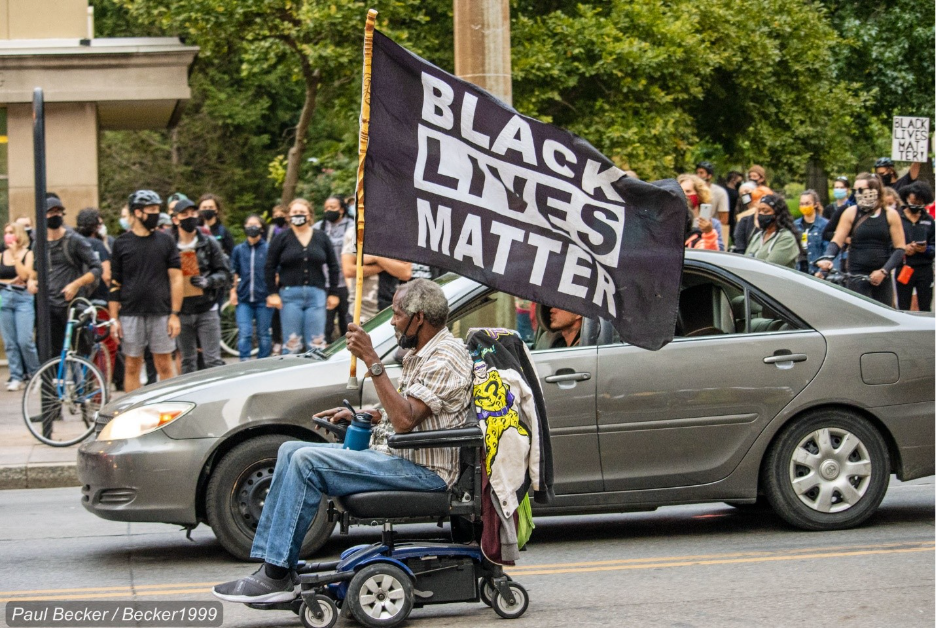
[Image description: A gray-haired Black man rolls down the street in a power chair while flying a “Black Lives Matter” flag at a protest against police brutality and racism.
Community Conversation
Please join us for one of two virtual community conversations facilitated by Disability Network Southwest Michigan, offering the opportunity to connect with others taking the challenge and gain deeper learning from experts in the field.
Register today:
__________________________________________________________________________________________
Injustice in the Justice System
Content Note: This topic and some of its associated resources describe law enforcement brutality, physical restraint, incarceration, isolation and solitary confinement, domestic violence, sexual violence, hate crimes, mental health crisis, self-harm, suicide attempts, bodily waste, racism, audism, and ableism.
People with disabilities are among the most vulnerable victims of crime and are disproportionately criminalized by the US justice system.
During the mid-1900s, disability rights activists successfully campaigned to close dozens of state-run institutions and psychiatric hospitals, where disabled people had long been segregated under the guise of care and protection. The goal was for people with disabilities to live and receive supportive services in their homes and communities, instead of being confined to institutional settings. Today, those institutions have been replaced with prisons and jails, and people with disabilities are overrepresented in them. Prisons and jails are among the nation’s largest providers of mental health services, but they are woefully inadequate in supporting their disabled population. Over half of incarcerated people in the US report having some type of disability. This staggering statistic reflects two facts: 1) People with disabilities are at high risk of incarceration; and 2) People who are incarcerated are at high risk of developing disabilities, even if they were not disabled prior to prison or jail.
Multiple factors play into the criminalization of people with disabilities. Education inequality raises risk through the school-to-prison pipeline . The school-to-prison pipeline describes how policies within education funnel marginalized students into the criminal legal system. Additionally, police, lawyers, and judges often have insufficient knowledge about disabilities and fail to ensure due process rights for disabled people. Ableism within the criminal legal system can lead to false confessions, convictions of innocent people, and unnecessary, violent police encounters.
It is estimated that up to one-half of people killed by US law enforcement each year have a disability. According to the Washington Post , since 2015, on-duty police officers have shot and killed almost 2,000 people who were experiencing a mental health crisis. The criminalization of homelessness, sex work, drug use, and other social issues that disproportionately affect disabled people only furthers this injustice and increases the risk of violent encounters with police. Disabled people who are also People of Color or lesbian, gay, bisexual, transgender, queer, intersex, asexual+ (LGBTQIA+) are particularly at risk of both police violence and incarceration.
Law enforcement is often first to respond to a scene, but most law enforcement personnel are not trained healthcare workers or mental health specialists. Culture and the media spread the misconception that people with certain disabilities are violent, unpredictable, and scary, so people often misinterpret harmless disability-related behavior as a threat. All too often, non-disabled people call the police on disabled people for simply existing in public, especially those with intellectual, developmental, or mental health disabilities. Community resources can serve as powerful alternatives to calling the police that can save lives.
Additionally, people with disabilities are also almost four times more likely than non-disabled people to be victims of other violent crimes . One in three robbery victims is disabled. People with intellectual disabilities are seven times more likely than non-disabled people to be victims of sexual assault, according to unpublished data from the US Department of Justice, as reported by NPR . In recent years, the frequency of crime against disabled people in America is rising , and disability justice advocates say action is needed to reverse this trend.
Transformative justice offers a way to change the conditions that lead to harm to stop the cycle and prevent future harm. According to Mia Mingus, “At its most basic, transformative justice seeks to respond to violence without creating more violence and/or engaging in harm reduction to lessen the violence.” We must dismantle ableism and racism by restructuring our criminal legal system, emergency response procedures, medical and mental health supports, and victim services to create a truly just society for all people in America.
Take Action:
Building community connectedness and holding ourselves accountable to each other is necessary to stop cycles of harm and prevent violence . Get to know your neighbors, including disabled and unhoused community members. Support community initiatives that promote disabled people’s well-being, such as supportive housing, harm reduction services, inclusive sexuality education , and mutual aid programs. Learn about local resources, so you can contact them instead of calling law enforcement when you encounter an issue or have a concern. In our spheres of influence, we can each challenge bias, form meaningful relationships, and build more inclusive communities where people with disabilities can thrive without fear of violence.
Comments (0)
Popular

Dive in
Related
External Content
"I'm Going to Take Care of You": A Day at a Free Tax Prep Site in Lansing
May 19th, 2026 • Views 1
External Content
"I'm Going to Take Care of You": A Day at a Free Tax Prep Site in Lansing
May 19th, 2026 • Views 1