

equity
October 9, 2026
Day 7: Disability & The Whole Person
# Challenge
# Disability
# Equity
21-Day Disability Equity Challenge
TODAY'S CHALLENGE TOPIC: Disability & The Whole Person
Note: If you've not yet read today's intro, please find it at the bottom of this post.
Read:
- Anna Claire Vollers, The 19th – How a Legal Challenge Over Gender Dysphoria Became a Fight for Disability Rights
- Joe Stramondo, Disability Visibility Project – Immigrant Rights Are Disability Rights
- Tuttleturtle, CommunicationFIRST – What Does Gender Have to Do with Presuming Competence?
- The Opportunity Agenda – Ten Tips for Putting Intersectionality into Practice
Watch:
- Keri Gray, Ford Foundation – Intersectionality & Disability (2:11, includes captions, audio described video option, and transcript)
- American Masters, PBS – Renegades: Disabled Black Panther Brad Lomax (10:19, includes captions, ASL-interpreted video option, audio-described video option, and transcripts)
- Rooted in Rights – Crip Queer Pride with Daisy Wislar (3:36, includes captions, audio description, and transcript)
Listen:
- The Independent Podcast – Race, Gender & Disability Justice with Vilissa Thompson (39:04, includes transcript and captioned video)
- Down to the Struts Podcast – Disabled Women and Economic Justice with Marissa Ditkowsky (25:18, Transcript )
- What’s Up WID Podcast – The Intersections of Race, Class, Gender, Sexuality, and Disability (35:39, ASL Interpreted Video , Transcript )
Discussion:
- List the different identities you have. If you are part of more than one marginalized group, how does this impact your experience of marginalization or oppression? If you hold one or no marginalized identities, how might your day-to-day experiences differ from those holding multiple marginalized identities?
- Think about a program, service, or policy that was designed originally for one oppressed group (same-sex marriage, senior housing, women’s domestic violence shelter, Individualized Education Program). Are there ways this program, service, or policy serves those holding dominant identities better than those holding multiple oppressed identities?
Image:
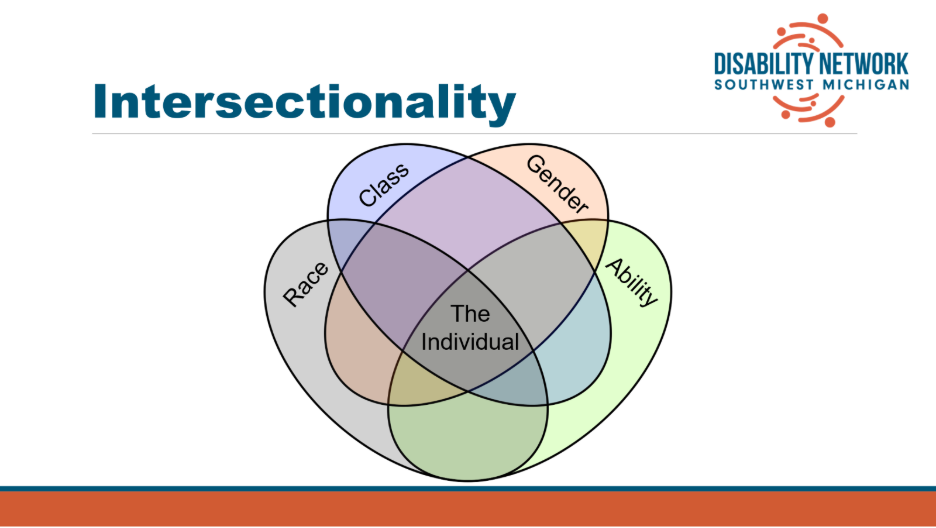
[Image description: An illustration titled “Intersectionality” shows a Venn diagram with four different-colored overlapping ovals labeled "Race," "Class," “Gender,” and "Ability." The section where all four ovals overlap is labeled "The Individual." Disability Network Southwest Michigan blue and orange logo in upper right corner of the image.
Community Conversation
Please join us for one of two virtual community conversations facilitated by Disability Network Southwest Michigan, offering the opportunity to connect with others taking the challenge and gain deeper learning from experts in the field.
Register today:
___________________________________________________________________________________________
Disability & the Whole Person
Every person holds multiple identities. These identities can include race, gender, sexuality, disability, socioeconomic status, religion, and more. It is essential to acknowledge these different identities and their impact on the way each individual experiences the world. Recognizing this diversity helps us understand the complexity of people’s lives.
Intersectionality is a concept that helps us understand how multiple oppressed identities show up together. Many people have described the concept throughout history, but the term intersectionality was coined in 1989 by Kimberlé Crenshaw to describe how systems of inequality based on sex, race, ethnicity, sexual orientation, gender identity, disability, class, and other forms of discrimination “intersect” to create unique effects. For example, a Black transgender woman with a disability experiences oppression in a different way than simply adding up racism, transphobia, sexism, and ableism. Instead, each form of oppression amplifies the others because she is experiencing all the layers of those identities at the same time.
Research shows that people with disabilities who are also members of other marginalized groups, such as people of color and lesbian, gay, bisexual, transgender, queer, intersex, asexual+ (LGBTQIA+) people , face increased risks of discrimination. This discrimination includes not only the prejudice of individual people, but systemic injustice. Systemic injustice describes how discriminatory policies and practices from the past still impact people today. For example, women, disabled people, and people of color did not always have the right to vote in the United States, so many laws still exist that reflect decisions made without the input of these groups. Due to systemic injustice, people from historically excluded groups are still subject to discrimination, inequitable policies, and the abuse of power by institutions. This means they are more likely to live in poverty, become victims of violence , experience police brutality , face housing discrimination , and a wide range of other injustices. These overlapping forms of discrimination can compound the difficulties people face, making their experiences of marginalization more intense and multifaceted.
People of all marginalized groups are also represented in the disability community. Organizations should consider intersectionality when developing inclusive programs and services. To achieve disability justice, we must center the needs of the people who are impacted by oppression in all its forms and build support between movements. These alliances will strengthen our efforts and create more comprehensive and effective strategies for change. When we understand intersectionality, we can better transform our society into a world where everyone can thrive while celebrating all the parts of who they are.
Take Action:
By understanding how all oppression is connected, we can work more effectively to dismantle ableism and create true inclusion for all disabled people, including people of color, women, LGBTQIA+ people, and people living in poverty or ALICE households . If you use social media, following disabled content creators from diverse backgrounds can help you develop an intersectional perspective on disability. When you are planning or making decisions that impact others, ask yourself, “Whose point of view is missing here?” and partner with people who have that lived experience to gain their insight.
Comments (0)
Popular

Dive in