

equity
October 23, 2026
Day 17: Housing Inequality
# Challenge
# Disability
# Equity
21-Day Disability Equity Challenge
TODAY'S CHALLENGE TOPIC: Housing Inequality
Note: If you've not yet read today's intro, please find it at the bottom of this post.
Read:
- Robert Davis, Invisible People – How Shelter Systems Fail Disabled People Experiencing Homelessness
- Leah Ida Harris & Liat Ben-Moshe, Truthout – Executive Order Criminalizing Houselessness Reveals a Familiar Dystopia
- Bianca Gonzalez, Prism – Disabled People of Color Continue to Fight for Accessible Housing
- Rachel Litchman, Disability Visibility Project – Reflecting on My Experiences as a Homeless Youth With Disabilities
Watch:
- Disability Reframed, PBS News Hour – People with Disabilities Face Extra Hurdles Amid National Housing Shortage (10:26, includes captions, ASL interpretation, and transcript)
- Michigan State Housing Development Authority – Brian Shares His MSHDA Down Payment Assistance Experience (2:22, includes captions and transcript)
- Fair Housing Center of Central Indiana – Sarah’s Housing Discrimination Story and Reasonable Accommodations (6:06, includes captions and transcript)
Listen:
- Quil Lawrence, NPR – Push to Institutionalize Homeless People May Include Veterans (11:08, includes text story, Transcript Link )
- Good Fit/Poor Fit Podcast, The Universal Design Project – Episode 109: Why Most Homes Fail - The Supply Problem (24:04, includes transcript)
- Move to Include Podcast, WXXI News – No Place Like Home: Why Accessible Housing Is Critical for People with Disabilities (34:17, includes transcript and captioned video)
Discussion:
- What are some ways that housing access for people with disabilities is already being addressed locally? If you aren’t aware of any, how might you learn more?
- Safe, affordable, and accessible housing offers more than a place to sleep and live. What feelings show up for you when you think about your home?
Image:
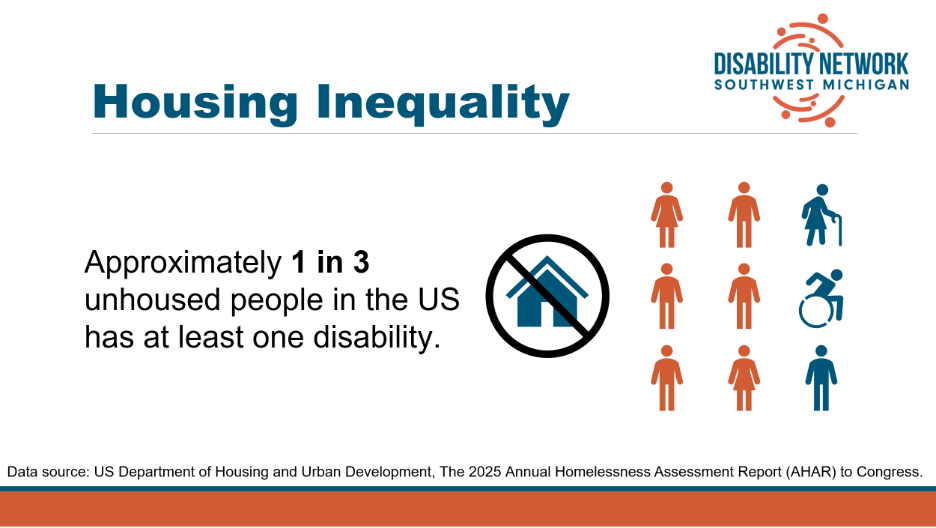
[Image description: An infographic titled “Housing Inequality” reads: “Approximately 1 in 3 unhoused people in the US has at least one disability.” To the right of the text is an illustration depicting this statistic. An icon of a crossed-out house is next to nine different person icons representing unhoused people. Six of these icons are non-disabled people, in orange. Three of these icons are disabled people (one using a cane, one using a wheelchair, and one with a non-apparent disability), in blue. Disability Network Southwest Michigan blue and orange logo in upper right corner of the image.
Data source: US Department of Housing and Urban Development, The 2025 Annual Homelessness Assessment Report (AHAR) to Congress. ]
Community Conversation
Please join us for one of two virtual community conversations facilitated by Disability Network Southwest Michigan, offering the opportunity to connect with others taking the challenge and gain deeper learning from experts in the field.
Register today:
__________________________________________________________________________________________
Housing Inequality
Although laws exist to protect the housing rights of people with disabilities, blanket policies and procedures can still operate in discriminatory ways when they fail to account for disability-related needs. These one-size-fits-all approaches can create or reinforce barriers to affordable and accessible housing, disproportionately increasing the risk of housing insecurity for people with disabilities.
One example of a discriminatory housing practice is a standard policy requiring applicants to earn three times the monthly rent, which can disproportionately exclude people with disabilities and create adverse barriers to accessing housing. According to a Brandeis University report , about a quarter of people with disabilities spend half or more of their monthly income on their rent or mortgage. Because 52% of disabled people in the US struggle to afford basic needs, many people with disabilities don’t make enough to pay market rent rates and are left looking for affordable housing without success. Often, affordable housing applicants are put on waiting lists that range from six months to a year and a half.
Another example of disability discrimination in housing is a total “no animals” policy that prevents a tenant with a mental health disability from having an Emotional Support Animal (ESA) as a disability-related accommodation. Under the Fair Housing Act , assistance animals, including ESAs and service animals, are not considered pets. Denying assistance animals through a one-size-fits-all policy violates the law because it limits disabled people’s opportunity to access and enjoy equal benefits of housing.
When you add the need for accessibility to the equation, finding affordable housing is considerably more challenging. The Department of Housing & Urban Development (HUD) reports that 19% of United States households include someone who needs accessible housing due to a mobility disability, yet 40% of these households live in a place where they must climb stairs to enter and exit. The Fair Housing Act requires most new multi-family housing units in the US to be built with certain accessibility features, but there are no federal accessibility requirements for single-family homes.
Housing insecurity is an issue that disproportionately impacts people from various marginalized groups, including the disability community. The term “housing-insecure” can refer to homelessness, but it can also refer to people who, due to financial reasons, must consistently move from place to place, live in overcrowded, multi-family homes, or are unable to meet their housing costs and face utilities shut-offs, eviction, or foreclosure. Because people with disabilities are twice as likely to live in poverty as their non-disabled peers, many disabled people face all these issues.
According to a 2025 HUD report , approximately 30% of people who are unhoused in the US have a disability. Some people prefer the terms “unhoused” or “houseless” over the term “homeless.” Supporters of these terms say they better capture their situation because home can include community, memories, family, and friends, while a house is the actual structure that unhoused people lack. Other people prefer the term “homeless,” believing that it better describes their experience.
Many shelters for unhoused people across the country are not accessible to people with disabilities, leaving some unhoused disabled people with only the option of sleeping outdoors. Bans on camping in many jurisdictions have led to unhoused people being arrested simply for sleeping outside in public spaces. In recent years, some lawmakers have even proposed institutionalizing all unhoused disabled people, which would reverse many of the hard-won victories of the disability rights movement. Emergency shelters, incarceration, and institutionalization cannot solve the long-term problem of lacking a house. Years of research have shown that the Housing First model is an effective way to end homelessness at the individual level. Housing First is a policy that offers unconditional, permanent housing as quickly as possible to unhoused people, along with supportive services afterward.
The lack of fully accessible and truly affordable housing across the country combines with other economic disparities to significantly limit disabled people’s opportunities for housing. Policymakers must create and enforce policies that require inclusive rental and real estate practices, accessible housing design, and promote Housing First approaches to homelessness. Everyone deserves access to safe, affordable, and accessible housing.
Take Action:
In 2022, Michigan published its first-ever Statewide Housing Plan , and the Michigan State Housing Development Authority (MSHDA) is now seeking public input for the Statewide Housing Plan 2.0 update . You can take the Michigan Statewide Housing Survey and encourage MSHDA to promote affordability, accessibility, and social housing opportunities in their new plan. At the local level, you can advocate to decriminalize homelessness , enact Housing First policies, fund programs to make existing housing more accessible, and build affordable, universally designed housing.
Comments (0)
Popular

Dive in