

Day 11: Economic Inequality
# Disability
# Equity
21-Day Disability Equity Challenge
October 15, 2026Learn More:
Read:
· Amir Browne, AbleNews at The Viscardi Center – National Study Finds an Even Tougher Financial Picture for the Disabled Community
· Meghan Beaudry, Rooted in Rights – For Chronically Ill People, the Path to Financial Security Is Anything But Straight
· Sarah Luterman, The 19th – SNAP Benefits Are a Lifeline, Especially for People with Disabilities
Watch:
· Dessa Cosma, Ford Foundation – Economic Justice & Disability (1:39, includes captions, audio-described video option, and transcript)
· United for ALICE – Introduction to ALICE in Focus: People with Disabilities (14:26, includes captions and transcript)
· National Center on Health, Physical Activity and Disability – Understanding the Employment Gap for People with Disabilities (5:46, includes captions and transcript)
Listen:
· Selena Simmons-Duffin, NPR – People with Serious Illnesses Could Lose Medicaid Under New Work Rules, Advocates Say (3:54, includes text story, Transcript )
· The Disability Squeeze Podcast – Episode 10: Sarah Todd Hammer on the Time & Financial Costs of Living with a Disability (22:53, includes transcript and captioned video)
Discussion:
· Think about the disabled people in your life. What are some additional expenses they might have that non-disabled people don’t?
· Look at a job description for an organization that is hiring. Which of the requirements in the job listing might discourage a qualified person with a disability from applying for the job? How could the requirements be rephrased to include disabled applicants?
· What are some programs that could be implemented locally to address income inequality, high unemployment rates, food insecurity, or cost-of-living disparities among people with disabilities?
Image:
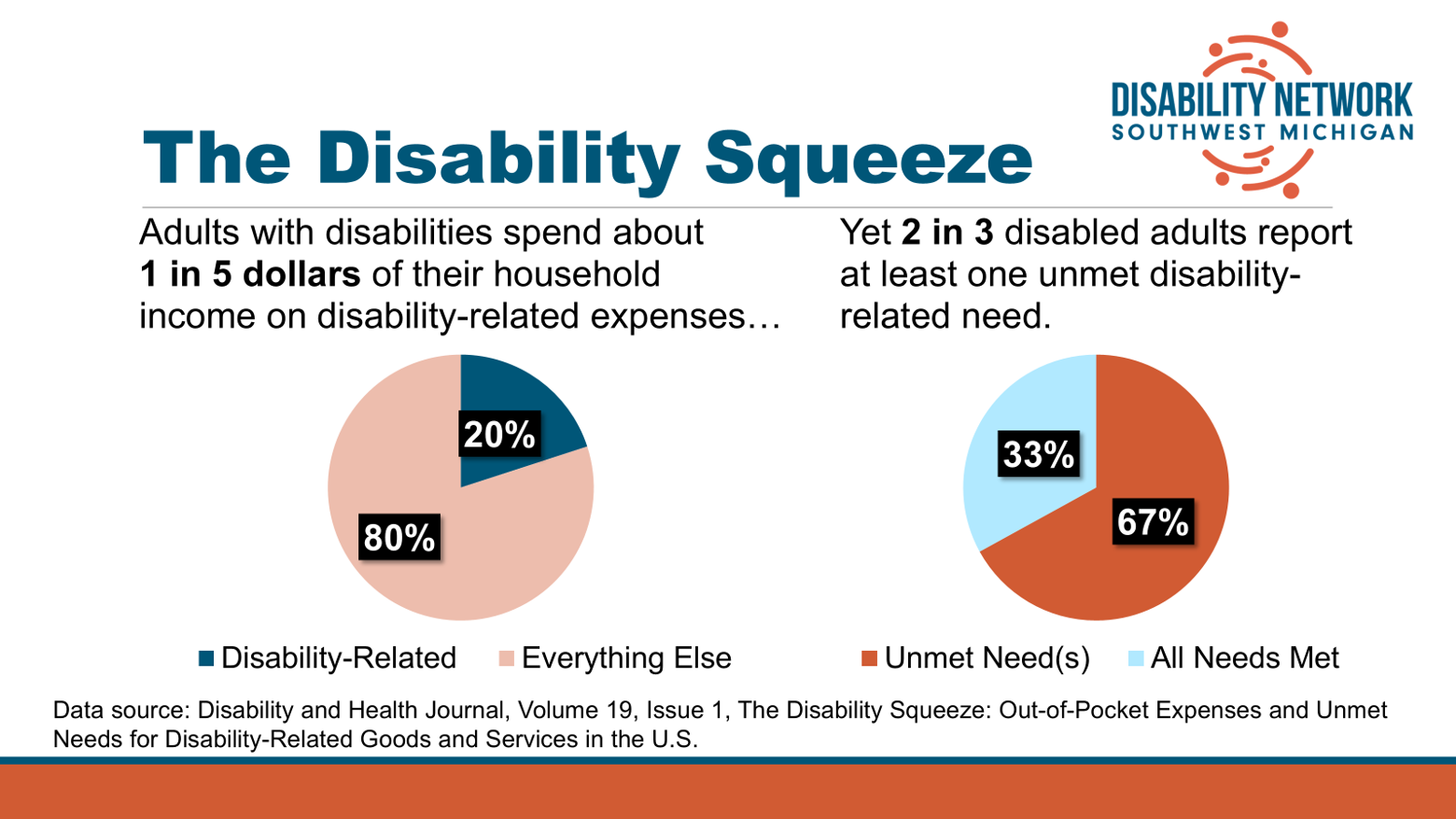
[Image description: Illustration titled “The Disability Squeeze” with 2 pie charts. Text reads, “Adults with disabilities spend about 1 in 5 dollars of their household income on disability-related expenses… Yet 2 in 3 disabled adults report at least one unmet disability-related need.” The first pie chart shows 20% Disability-Related Expenses and 80% Everything Else. The second pie chart shows 67% Unmet Need(s) and 33% All Needs Met. Disability Network Southwest Michigan blue and orange logo in upper right corner of the image.
Data source: Disability and Health Journal, Volume 19, Issue 1, The Disability Squeeze: Out-of-Pocket Expenses and Unmet Needs for Disability-Related Goods and Services in the U.S. ]
_______________________________________________________________________________________________________________
Day 11: Economic Inequality
Economic injustice is a major issue affecting the disability community. Adults with disabilities are twice as likely to be unemployed and twice as likely to live in poverty as their non-disabled peers. Disabled full-time workers earn only 83 cents on the dollar when compared to their non-disabled peers. Even though people with disabilities have less income, their cost of living is significantly higher than that of people without disabilities. Disability-related needs are often expensive and not always covered by insurance. In fact, adults with disabilities in the US spend about 20% of their household income on disability-related goods and services each year, yet 67% of disabled adults still report at least one unmet need.
According to the Center for Research on Disability , 20.3% of disabled people in the US lived below the Federal Poverty Level in 2024, but this level does not reflect the financial realities many people face. Since 2009, United For ALICE has partnered with United Ways across the country to highlight the growing number of families struggling to meet basic needs. ALICE (Asset Limited, Income Constrained, Employed) households earn above the Federal Poverty Level yet struggle to afford basic expenses. The ALICE data on disability for 2019 shows that 52% of people with disabilities in the US were unable to afford basic needs that year. According to the Urban Institute , 41.5% of disabled adults in the US experienced food insecurity in 2025, compared to 18.3% of non-disabled adults.
For over 30 years, the Americans with Disabilities Act (ADA) has provided a pathway for people with disabilities to be included in the workforce. Title I of the ADA prohibits most private employers, state and local governments, employment agencies, and labor unions from discriminating against qualified individuals with disabilities. The ADA spans all areas of employment, including hiring, compensation, opportunities for promotion, and on-the-job training. Unfortunately, qualified applicants with disabilities still experience employment discrimination and are often overlooked as they seek jobs.
Many people with disabilities rely on Medicaid or Social Security benefits to survive. For disabled people who cannot work, government benefits are often their only source of income. Yet expenses often outpace benefit payments, leaving these people in financial hardship. Individuals who qualify for Supplemental Security Income (SSI) from the Social Security Administration can have no more than $2,000 in assets, including savings, and married couples on SSI are limited to $3,000. Asset limits like these may prevent disabled people from saving enough money to prepare for emergencies or achieve long-term financial goals like homeownership. Unfortunately, many SSI and SSDI recipients who acquired a disability before age 46 don’t know about recent legal changes that allow them to save more money in ABLE accounts .
For people with disabilities who can work, state and federal governments impose strict income limits and work requirements to qualify for Medicaid, food assistance, and other benefits. Most income limits do not account for the thousands of extra dollars disabled people spend each year on disability-related expenses. Disabled workers may struggle to meet or document work requirements because they are more likely to work part-time or be self-employed . As a result, income limits and work requirements contribute to the cycle of financial instability.
Changes to our social service and financial systems are necessary for people with disabilities to thrive, rather than struggle to meet their basic needs. As a community, we can be intentional in creating social services, benefit programs, and employment opportunities that address socioeconomic inequalities for people with disabilities.
Take Action:
At the federal level, you can advocate for legislation to improve economic security for disabled people, such as the SSI Savings Penalty Elimination Act ( H.R. 2540 / S. 1234 ) and the Marriage Equality for Disabled Adults Act ( H.R. 1389 ). Locally, you can support creating affordable, accessible housing and expanding public transportation services, which are critical to employment for disabled people who don’t drive. If you work or volunteer, you can encourage your organization to implement inclusive employment practices, program eligibility requirements, and equitable pricing. Wherever we have influence, we can each work to reduce the burden on people with disabilities to prove they are “disabled enough” or “poor enough” to deserve to have their needs met.
Comment (1)
Popular

Dive in