

equity
October 7, 2026
Day 5: Ableism
# Challenge
# Disability
# Equity
21-Day Disability Equity Challenge
TODAY'S CHALLENGE TOPIC: Ableism
Note: If you've not yet read today's intro, please find it at the bottom of this post.
Read:
- Center for Disability Rights – #Ableism
- Access Living – Ableism 101
- Neurodivergent Insights – What Ableism Looks Like: Examples Across Systems, Culture, and Self
- YoungMinds – Everyday Ableism: The Impact on Mental Health
Watch:
- Isa Stahr M.S. – Disability 101: What Is Ableism? (16:19, includes captions and transcript)
- Harvard Business Review – How to Be an Anti-Ableist Ally at Work (10:12, includes captions and transcript)
- Axe-con 2025, Deque Systems – Combating Ableism and Driving Positive Change with Alice Wong (54:08, includes captions and transcript)
Listen:
- The I Can’t Stand Podcast – What Is Ableism? What to Do When People Say It Doesn’t Exist? (13:23, includes transcript)
- Disabled by Society – The Unlearning Ableism Podcast (Series available on multiple platforms, Transcripts )
Discussion:
- What assumptions about disability have you seen or experienced?
- What is one action you could take to reduce ableism and improve accessibility?
- What role do allies play in confronting ableism? Provide some examples.
- Join the Day 5 Discussion
Image:
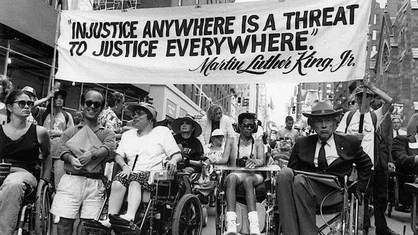
[Image description: Disability rights protesters march while carrying a large banner that reads, “Injustice Anywhere Is a Threat to Justice Everywhere. Martin Luther King, Jr.” Key figures in the foreground include Judy Heumann and Justin Dart, Jr.
Community Conversation
Please join us for one of two virtual community conversations facilitated by Disability Network Southwest Michigan, offering the opportunity to connect with others taking the challenge and gain deeper learning from experts in the field.
Register today:
___________________________________________________________________________________________
Ableism
Ableism is the systemic oppression, mistreatment, and marginalization of people with disabilities. A simple way of thinking of ableism is the unfair treatment of disabled people. It is rooted in the belief that people with disabilities are something that needs to be feared, fixed, or viewed as less desirable than being non-disabled. These beliefs influence attitudes, policies, and practices, often creating barriers that exclude people with disabilities from full participation in society. This is often done without people knowing they are doing it.
Ableism isn't always intentional. It can be obvious, such as refusing to hire someone because they have a disability, or it can be subtle, like assuming a disabled person needs help without asking first. It can also appear in the physical environment, technology, healthcare, education, employment, transportation, media, and countless other aspects of daily life.
Examples of ableism include:
- Designing a building with only stairs and no accessible entrance.
- Assuming a person with a disability is less qualified for a job because of their disability.
- Using inaccessible websites, mobile apps, or digital documents that exclude people who use screen-reading technology.
- Speaking to a companion or caregiver instead of directly to a disabled person.
- Describing people with disabilities as "inspirational" simply for living their everyday lives, rather than recognizing their skills, accomplishments, or individuality.
Ableism exists at many levels and is generally grouped into three categories:
Individual ableism consists of a person's attitudes, assumptions, and behaviors toward people with disabilities.
Example: A hiring manager assumes that a blind applicant would not be able to use workplace technology, despite accessible software and reasonable accommodations being widely available.
Systemic (or institutional) ableism consists of policies, procedures, practices, or environments that create barriers for people with disabilities.
Example: A healthcare system requires patients to use self-service check-in kiosks that are not compatible with screen readers and offers no accessible alternative, preventing some patients from checking in independently.
Internalized ableism occurs when people with disabilities begin to believe the negative messages and stereotypes society has about disability and apply those beliefs to themselves. Over time, this can lead to a disabled person losing confidence, becoming less willing to ask for help or accommodations, and not pursuing their personal goals.
Example: A college student chooses not to request classroom accommodations because they worry others will think they are receiving special treatment or that asking for support means they are less capable.
Challenging ableism requires more than changing individual attitudes. It also means examining the systems, environments, and assumptions that create barriers. Laws like the Americans with Disabilities Act (ADA) provide important protections, but true inclusion happens when accessibility and disability are considered from the beginning. rather than added later.
Organizations led by and for disabled people, such as the National Council on Independent Living , Centers for Independent Living , and the Autistic Self Advocacy Network , continue to drive meaningful change by advocating for accessibility, influencing public policy, and ensuring disabled voices are part of the decisions that affect their lives.
Allies also play an important role by listening to disabled people, challenging ableist assumptions, and helping create communities where everyone belongs. Recognizing ableism is the first step toward building communities where disability is valued as part of human diversity rather than viewed as something to be fixed.
Take Action:
Ableism often shows up in everyday routines rather than in intentional acts of exclusion. One way to challenge it is by asking whether disabled people have been included in the planning process from the beginning. For example, accessibility should be considered at the start of every event or project. Plan ahead by budgeting for supports like microphones, easy-to-read materials, quiet spaces, and accessible seating. Include a place on the registration form for accommodation requests and assign someone to follow up on requests before the event. This helps ensure accessibility is built into the planning process from the beginning.
Comments (2)
Popular

Dive in