

Day 13: Disability, Family, & Relationships
# Disability
# Equity
21-Day Disability Equity Challenge
October 19, 2026TODAY'S CHALLENGE TOPIC: Disability, Family, & Relationships
Note: If you've not yet read today's intro, please find it at the bottom of the post.
Read:
- Joseph Shapiro, NPR – Couples Say They Can't Get Married Because of This Government Program's Outdated Rules
- Joey’s Journeys – Dating and Relationships with a Disability
- United for ALICE – Financial Hardship Among People with Disabilities
Watch:
- FOX6 News Milwaukee – Disabled Couples Can't Get Married Without Losing Benefits (7:47, includes captions and transcript)
- PBS News Hour – New Book Gives Parenting Lessons from The Disabled Community (6:33, includes captions, ASL interpretation, and transcript)
- Carrie Wade, Rooted in Rights – Did Love Win? (3:19, includes captions, audio description, and transcript)
Listen:
- Everything You Know About Disability Is Wrong Podcast – Love, Humor, and Real Life: Shane & Hannah (1:01:12, includes transcript and captioned video)
- Embodied Podcast – Parenting Wisdom from an Interabled Couple (50:21, Transcript )
Discussion:
- What stereotypes have you heard about people with disabilities in dating, marriage, or parenting?
- How can assumptions about disability affect someone’s opportunities to build relationships or raise a family?
- What is one idea or assumption that changed for you after today’s reading?
Image:
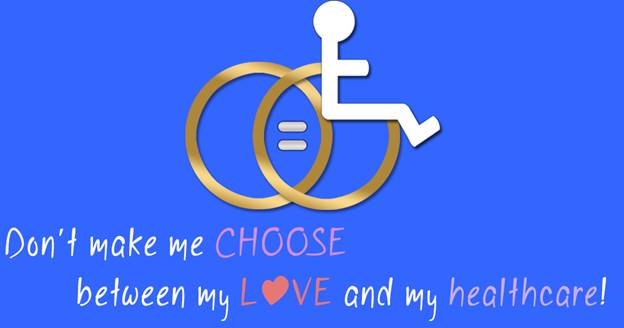
[Image description: An illustration on a bright blue background of two gold rings linked together with an equal sign in the middle. One gold ring forms the wheel of a wheelchair with a person in it. Text reads: “Don’t make me choose between my love and my healthcare!” The ‘O’ in love forms a pink heart.
Community Conversation
Please join us for our second of two community conversations facilitated by Disability Network Southwest Michigan, offering the opportunity to connect with others taking the challenge and gain deeper learning from experts in the field.
Register today:
________________________________________________________________________________________________________________
Disability, Family, & Relationships
For many people, dating, getting married, and raising a family are simply part of life. People with disabilities often want these same things, but they may face barriers and assumptions that most people never have to think about.
One assumption many people still hold is that disabled people are not interested in dating or romantic relationships. Others believe they would not make a good spouse or partner simply because they have a disability. Some even assume that if a disabled person gets married, their spouse becomes their caregiver instead of their equal partner. The truth is that healthy relationships are built on trust, communication, respect, and shared experiences. Disability may change how someone does certain things, but it does not determine whether they can love someone or be loved.
For some people with disabilities, government rules and benefit programs can also affect their relationships. Programs such as Supplemental Security Income (SSI) and Medicaid have created what many in the disability community call the " marriage penalty ." Depending on a couple's financial situation, getting married or combining households can reduce or eliminate benefits essential for healthcare, personal support services, or financial security. Because of the way these programs are set up, some people with disabilities must think about more than just love when deciding whether to get married. They also need to consider whether they can afford to lose the benefits they depend on.
The challenge extends beyond marriage. Many public assistance programs have strict income and asset limits. This can create what is known as a " benefits cliff ," where earning a little more money or getting married may cause someone to lose important supports before they are financially stable. United For ALICE found that 48% of disabled Michigan residents live below the ALICE Threshold, meaning they struggle to afford basic living expenses. Yet in 2019, only 18% of people with disabilities living below the ALICE threshold received Supplemental Security Income (SSI) . This shows that many disabled people who are struggling financially do not receive SSI benefits.
People with disabilities also become parents every day. They raise children, help with homework, attend school events, and create loving homes just like parents without disabilities. Some may use adaptive equipment, different parenting techniques, or additional supports, but these differences do not make them less capable of being good parents.
Unfortunately, parents with disabilities are often treated differently from parents without disabilities. They may face questions about whether they should have children or whether they are capable of raising them. Research has shown that disabled parents are more likely to become involved with Child Protective Services, and disability itself can influence decisions about whether children remain with their families. The National Council on Disability found that parents with disabilities continue to experience widespread discrimination in child welfare and family court systems despite legal protections under the Americans with Disabilities Act (ADA) .
The discrimination faced by parents with disabilities is rooted in a long history of ableism. Ableism is the belief that people with disabilities are less worth, less capable, or less deserving of the same rights as people without disabilities. For decades, people with disabilities were discouraged from marrying or having children, and many were forcibly sterilized because others believed they were unfit to become parents. While society has made progress, continued injustices remind us that the right to make decisions about relationships, marriage, and family is still not equally protected for disabled people.
People with disabilities have the same hopes, dreams, and rights as anyone else when it comes to relationships and family. The biggest barriers are often not disability itself, but outdated policies, financial hardship, inaccessible communities, and assumptions about what disabled people can and cannot do. When we remove those barriers, we create communities where everyone has the opportunity to build the life and family they choose.
Take Action:
Take a moment to think about the messages you have heard about disability, relationships, and family life. Have you ever assumed that a disabled person would not want to date, marry, or have children? Have you questioned whether they could be a good partner or parent? If you work with families, consider whether your policies, practices, and expectations support parents with disabilities in the same way they support everyone else. The next time you hear someone make assumptions about disability, relationships, or parenting, take the opportunity to challenge those stereotypes with facts and respect. People with disabilities deserve to build meaningful relationships and families just like anyone else.
Comments (0)
Popular

Dive in