

equity
October 8, 2026
Day 6: Disability Inspiration
# Disability
# Equity
# Challenge
21-Day Disability Equity Challenge
TODAY'S CHALLENGE TOPIC: Disability Inspiration
Note: If you've not yet read today's intro, please find it at the bottom of this post.
Read:
- Lydia Moro, Disability Belongs – Inspiration Porn: What It Is, Why It’s a Problem, and What You Can Do
- Patrick Kane, BITE – Why Disabled Creators Should Own Their Own Narrative
- Dom Evans, Easterseals – All I Want Is Better Disability Representation
Watch:
- Stella Young, TEDx Sydney – I'm Not Your Inspiration, Thank You Very Much (9:02, includes captions and transcript)
- Your Disabled Truth – How Does Social Media Amplify Inspiration Porn? (3:19, includes captions and transcript)
- Props No More – Stereotypes About Disability in Media (9:32, includes captions, audio description, and transcript)
Listen:
- ListenABLE Podcast – Spencer West on the Truth About Being Seen (44:21, includes transcript and captioned video)
- The Accessible Stall Podcast – Episode 16: Inspiration Porn (50:17, Transcript )
Discussion:
- Stella Young came up with the term “inspiration porn” to help us understand how harmful it is to celebrate a person as exceptional simply for doing things that are part or day-to-day life, especially for the purpose of reducing people with disabilities as being an inspiration for non-disabled person.
- Think about an example of inspiration porn you’ve seen?
- What are the hidden or unspoken assumptions or messages this shares about people with disabilities?
- How can we celebrate disabled people’s achievements without making them into an inspirational story?
Image:
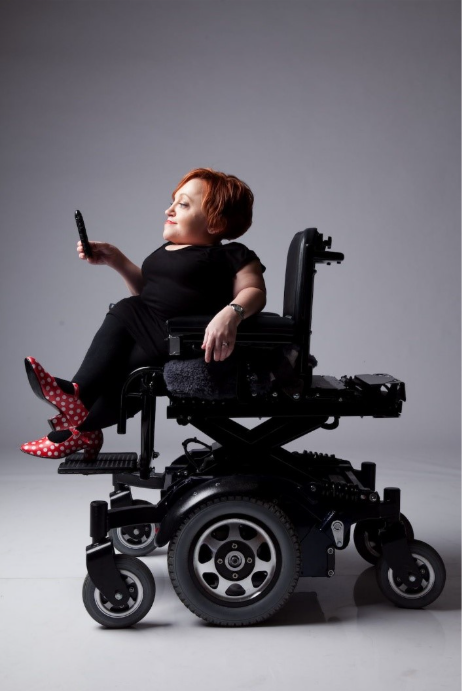
[Image description: Stella Young, a White woman with short, strawberry blonde hair, sitting in her power chair and smiling while looking at her cell phone. Stella wears a black T-shirt, black pants, and red high heels with white polka dots.
Community Conversation
Please join us for one of two virtual community conversations facilitated by Disability Network Southwest Michigan, offering the opportunity to connect with others taking the challenge and gain deeper learning from experts in the field.
Register today:
___________________________________________________________________________________________
Disability Is More Than an Inspiration Story
The term “Inspiration Porn” was coined by the Australian comedian and disability activist Stella Young . She used it to describe the way disabled people are used for the benefit of non-disabled people. This term is still widely used in the disability community, reflecting the problem that disability is often used as a motivational tool instead of being respected as part of human diversity.
We see this in social media posts, news stories, advertisements, and videos that present disabled people as inspirational for simply living their everyday lives. Typically, there is a message that goes something like “If this person can smile despite their disability, what’s your excuse?” At first, this may sound positive, but it sends a harmful message. It suggests that disabled people are here to teach a lesson to non-disabled people. Disabled people should be seen as whole people with their own goals, interests, and lived experiences.
Society often has lower expectations of disabled people, who may be given awards or special recognition for doing things that are part of daily life. A disabled person going to work, shopping, parenting, or being outside in their community is not extraordinary. Yet many disabled people have stories of strangers congratulating them for simply being out in public. Those comments are usually based on the assumption that disabled lives are a constant struggle or that disabled people must be trying to overcome their disability.
This focus on individual perseverance can also distract from the real barriers that need attention. Instead of asking why a building is inaccessible, why a workplace lacks accommodations, or why transportation is difficult to use, the conversation becomes about how inspiring a disabled person is for managing anyway. This shifts responsibility away from society and places it on the disabled person to adapt and try harder, rather than on society to become more inclusive.
People with disabilities can be inspiring, but the inspiration should come from their accomplishments, leadership, creativity, and other meaningful actions—not from merely existing with their disabilities. Many disabled individuals accomplish amazing things, like an athlete winning a championship, a student earning a degree, an artist creating an award-winning work of art, or an advocate creating policy change. These achievements can be inspiring for the same reasons anyone else’s achievements can be inspiring.
Stella Young said it best: “Disability doesn’t make you exceptional, but questioning what you think you know about it does.” This quote reminds us to move beyond stereotypes and see disabled people as human beings first and not tools to motivate others.
Take Action:
Before sharing a disability-related story, photo, or video, pause and ask yourself:
Am I sharing this because of the person’s actual achievement, or because I find their disability surprising?
Would I describe a non-disabled person doing the same thing as inspirational?
Does this content center the disabled person’s perspective, or does it make non-disabled people feel grateful or motivated?
One small action is to follow disabled creators, writers, and advocates on social media. Listen to how they describe their own experiences, and share content that highlights their ideas, work, and accomplishments, not the content that treats disability as inspirational. It is also important to remember that the disability community, like all communities, is complex and diverse. One person’s experience or perspective does not represent everyone in the disability community.
Comments (0)
Popular

Dive in