

Day 20: Disability Allyship
# Disability
# Equity
21-Day Disability Equity Challenge
October 28, 2026Today's Challenge Topic: Disability Allyship
Note: If you've not yet read today's intro, please find it at the bottom of this post.
Read
- Disability Belongs – The Role of Allyship in Disability-Inclusive Workplaces
- Meryl K. Evans – 10 Tips to Be a Disability Ally
- Centers for Disease Control and Prevention – Become a Disability A.L.L.Y. in Your Community and Promote Inclusion for All
- Emily Ladau – Demystifying Disability: What to Know, What to Say, and How to Be an Ally (Book, available in multiple formats)
Watch
- Your Disabled Truth – How Can Non-Disabled Allies Avoid Using Ableist Language? (2:20, includes captions and transcript)
- Youth Disability Advocacy Service – How Can I Be a Good Ally to the Disability Community? (3:15, includes captions and transcript)
- Paving the Way to Self-Determination, Disability Network Southwest Michigan – Rise Up! Disability History, Pride & Allyship (16:25, includes captions and transcript)
Listen
- Think Inclusive Podcast – How to Be an Ally To Disabled People with Emily Ladau (34:34, includes transcript)
- ListenABLE Podcast – The Advice You Need to Be a Disability Ally! (9:58, includes transcript and captioned video)
Discussion
- Think about a time when someone acted like your ally. What did they do to help you feel supported?
- How can you be an ally to disabled people?
- If you witnessed ableist language or behavior, how could you respond as an ally?
- Imagine your school, organization, or group you are part of is planning an event. What are three ways you could help make it more accessible before anyone asks for accommodations?
Image
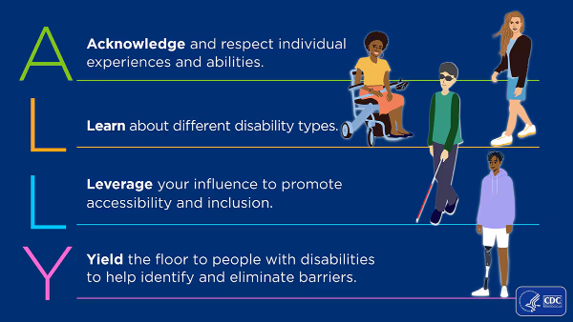
[Image description: Illustration on a dark blue background that features an acrostic word poem titled “Ally,” in which each letter of A-L-L-Y is highlighted vertically in a different color and stands next to a phrase that starts with that letter.
- A: Acknowledge and respect individual experiences and abilities.
- L: Learn about different disability types.
- L: Leverage your influence to promote accessibility and inclusion.
- Y: Yield the floor to people with disabilities to help identify and eliminate barriers.
To the right of the poem are illustrations of diverse individuals with disabilities, including a person in a wheelchair, a person with a white cane, a person with a prosthetic leg, and a person with a non-apparent disability. The logo for the Centers for Disease Control and Prevention is in the bottom right corner.
Attribution: Centers for Disease Control and Prevention , Become a Disability A.L.L.Y. in Your Community and Promote Inclusion for All (Updated 2026).]
___________________________________________________________________________________
Disability Allyship
Every movement for social change includes people who are directly impacted, people who uphold existing barriers, and people who are not directly impacted who choose to help create change. The latter are allies. In the disability community, allies are individuals who may not have a disability, but who actively work alongside disabled people to remove barriers, challenge ableism, and create more accessible communities. Like other marginalized groups, people with disabilities collaborate with their allies to advocate for access, equal opportunities, and meaningful social change.
To be an effective ally to the disability community, there are a few things everyone should know. First, allyship and neutrality are not the same. Allyship is an active choice, not a passive one. It is more than believing in disability rights—it means taking action to remove barriers, challenge ableist attitudes, and support people with disabilities in meaningful ways. Everyone has opportunities to learn, grow, and recognize where they may unintentionally contribute to ableism. The important part is being willing to listen, learn, and make changes.
Part of being an ally is taking time to reflect on your own actions and assumptions. Am I intentionally or unintentionally contributing to ableism? What stories have I been told that harm people with disabilities? How do I unlearn and grow in my thoughts and actions? Allies who recognize they have caused harm can take accountability, apologize when appropriate, and commit to learning from the experience. No one gets everything right all the time, but growth comes from listening, learning, and doing better. Allies who engage in self-reflection play an important role in advancing disability rights.
As allies educate themselves, they should be proactive in learning about the history of the Disability Rights Movement and the barriers people with disabilities continue to face today. Understanding landmark legislation such as the Americans with Disabilities Act (ADA) and staying informed about current disability-related issues can help allies become more effective advocates. Attending disability-related events, following disability-led organizations, and learning from disabled educators and advocates are meaningful ways to deepen your understanding. While every person is the expert in their own lived experiences, it’s also important to remember that not everyone wants to be, or should be, an educator on behalf of an entire community. When possible, compensate disabled speakers, trainers, and creators for sharing their expertise and lived experiences.
Another important aspect of allyship is amplifying the voices of people with disabilities rather than speaking for them. This means sharing their work, supporting their initiatives, and ensuring disabled perspectives are included in conversations about disability. Good allies also recognize that accessibility benefits everyone. Whether requesting captions for a meeting, ensuring a building is accessible, providing materials in multiple formats, or asking about accommodation needs before an event, small actions can make a meaningful difference.
When someone shares their experiences or identifies a barrier, believe them. It is not an ally's job to determine whether someone's disability or accommodation needs are valid. Instead, listen with respect, ask questions when appropriate, and continue learning from trusted disability organizations and people with lived experience.
Those within the disability community also have opportunities to be allies to one another. The disability rights motto, "Nothing About Us Without Us," applies across the disability community. People with different disabilities may experience ableism in different ways, but by listening to one another, respecting different perspectives, and working together, the movement becomes stronger.
Take Action:
Think about one way you can be an effective ally to people with disabilities this week. It could be as simple as learning from a disabled creator, making a document or event more accessible, speaking up when you hear ableist language, or asking how you can support someone instead of making assumptions. Allyship is not about having all the answers or never making mistakes. It is about listening, learning, and taking intentional steps to help create a community where everyone has the opportunity to participate and belong.
Comments (2)
Popular

Dive in