

equity
October 6, 2026 · Last updated on October 1, 2026
Day 1: The Foundations of Disability Justice
# Disability
# Equity
21-Day Disability Equity Challenge
TODAY'S CHALLENGE TOPIC: The Foundations of Disability Justice
Note: If you've not yet read today's intro, please find it at the bottom of this post.
Read:
- Ford Foundation: There Is No Justice Without Disability
- Disability History Museum – Virtual Disability History Library
- Sins Invalid – 10 Principles of Disability Justice (includes ASL interpreted video and Plain Language options)
- ADA National Network – What Is a Disability?
Watch:
- Ford Foundation – Social Justice: What’s Disability Got to Do with It? (5:08, includes captions, transcript, and audio-described video option)
- Rooted in Rights – What Are Disabilities? (1:32, includes captions, transcript, and audio description)
- Disability Law Center of Virginia – The Journey to Disability Rights (31:36, includes captions and transcript)
- Judith Heumann, TEDx MidAtlantic – Our Fight for Disability Rights—And Why We’re Not Done Yet (17:00, includes captions and transcript)
Listen:
- Ability Montana – 10 Disability Podcasts to Add to Your Listening Queue
Movie:
- Netflix on YouTube (free) – Crip Camp: A Disability Revolution (1:46:42, full movie, includes captions and transcript). Content Note: Mentions sex and sexually transmitted infections, contains profanity.
Discussion:
- Before today, what did you believe made a person disabled? Did you think they had to be getting a government disability benefit to be disabled? If so why did you think that?
- What did you learn today that was new or surprising?
- How have you learned about disability and the Disability Rights Movement? Was it from a person with a disability? If not should it have been?
- After today’s readings and videos, how has your understanding of disability changed, if at all?
- Visit our Day 1 Discussion Post to share any thoughts, insights or questions.
Image:
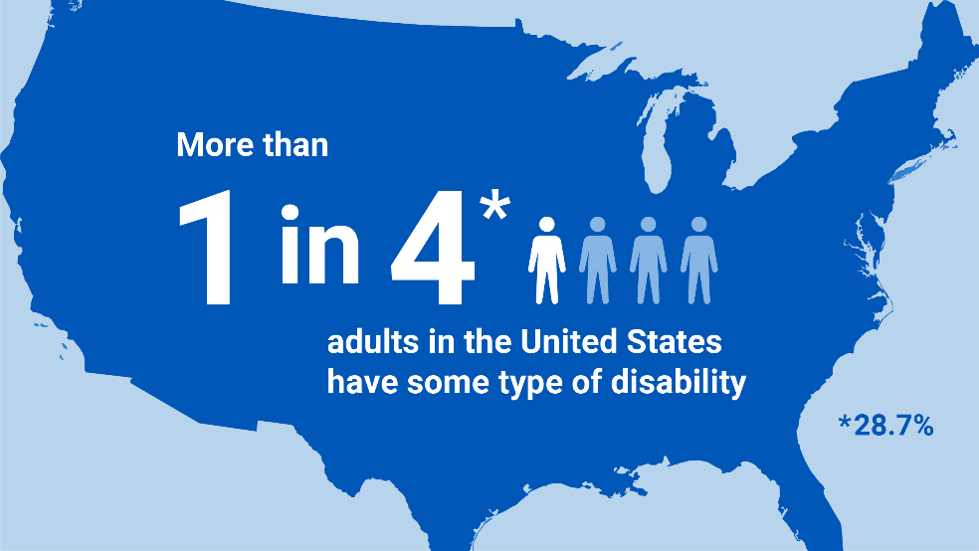
[Image description: Infographic with an outline of the United States containing four human icons. Text reads, “More than 1 in 4* adults in the United States have some type of disability. *28.7%” One of the human icons is white, and the other three are blue.
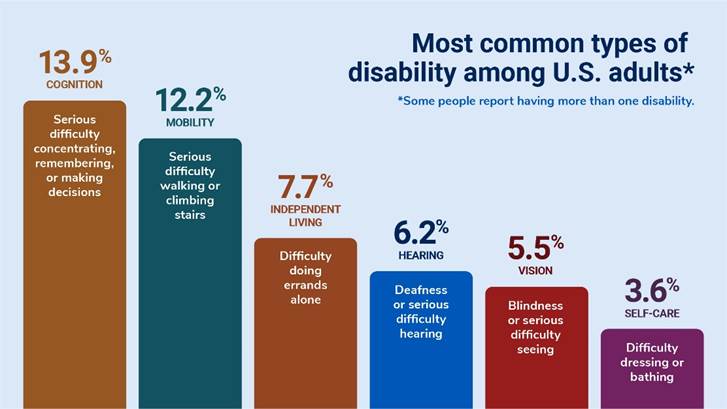
[Image description: An infographic titled "Most common types of disability among U.S. adults." A note below the title states, "Some people report having more than one disability."
The infographic displays six vertical bars of varying heights, each representing the percentage of U.S. adults who report a specific type of disability:
- 13.9% – Cognition: Serious difficulty concentrating, remembering, or making decisions.
- 12.2% – Mobility: Serious difficulty walking or climbing stairs.
- 7.7% – Independent Living: Difficulty doing errands alone.
- 6.2% – Hearing: Deafness or serious difficulty hearing.
- 5.5% – Vision: Blindness or serious difficulty seeing.
- 3.6% – Self-Care: Difficulty dressing or bathing.
The bars decrease in height from left to right, visually emphasizing that cognitive and mobility disabilities are the most common, while self-care disabilities are the least common of the six categories shown.
Community Conversation
Please join us for one of two virtual community conversations facilitated by Disability Network Southwest Michigan, offering the opportunity to connect with others taking the challenge and gain deeper learning from experts in the field.
Register today:
_________________________________________________________________________________________
Day 1: The Foundations of Disability Justice
Disability is a natural part of the human experience. It can be present at birth, acquired later in life, visible or non-apparent, temporary, episodic, or permanent. According to the Centers for Disease Control and Prevention (CDC) , approximately 28% of adults in the United States have a disability. Because many disabilities are non-apparent, you likely know or interact with people with disabilities every day without knowing it.
The Americans with Disabilities Act (ADA) defines a disability as a physical or mental impairment that substantially limits one or more major life activities. This legal definition determines who is protected under the ADA. While the definition is important for legal reasons, disability is also a natural part of human diversity and one of many things that make each person unique.
Having a disability does not automatically mean a person receives government benefits or services. Many people with disabilities work, attend school, raise families, and live independently without receiving benefits from the Social Security Administration (SSA) . Government benefits have specific requirements and are different from meeting the ADA’s definition of disability.
People with disabilities are the largest minority group in the United States. Unlike most other minority groups, disability is an identity that anyone can acquire at any point in their life. Disability crosses every race, ethnicity, age, gender, religion, sexual orientation, and socioeconomic background.
Financial security is also an important part of disability equity. According to the Michigan ALICE (Asset Limited, Income Constrained, Employed) Report , 48% of disabled people in Michigan live in households below the ALICE Threshold, meaning they are either living in poverty or earning above the federal poverty level but still unable to afford basic necessities. Financial hardship affects people from all backgrounds. People with disabilities often face additional barriers to employment, healthcare, transportation, and accessible housing, which can make it even harder to achieve financial stability.
Disability justice recognizes that people with disabilities have the same inherent value and deserve the same rights and opportunities as everyone else. It acknowledges that many problems disabled people experience are not caused by their disability itself but by physical, communication, policy, and attitudinal barriers that limit full participation in society. Disability justice calls on all of us to identify and remove barriers that restrict people with disabilities.
The disability rights movement has been part of the broader fight for civil and human rights for decades. People with disabilities have organized, protested, and advocated for equal access to education, employment, healthcare, housing, transportation, voting, and community life. Many people with disabilities also belong to other marginalized communities, making disability justice connected to conversations about race, gender, age, sexual orientation, and other identities.
Although the Civil Rights Act of 1964 prohibited discrimination based on race, color, religion, sex, and national origin, it did not include disability. It was not until the Americans with Disabilities Act was signed into law on July 26, 1990, that comprehensive federal civil rights protections were extended to people with disabilities. The ADA marked a significant milestone, but the work toward disability equity continues today.
Take Action:
Disability justice begins with recognizing that people with disabilities are the experts on their own lives. One way to put this into practice is by making sure disabled voices are included in conversations and decisions that affect them. Whether you're planning an event, creating a policy, or designing a program, ask: "Have people with disabilities been included in this process?" Including disabled people from the beginning leads to more inclusive and equitable outcomes.
Comments (2)
Popular

Dive in