

equity
October 26, 2026
Day 18: Healthcare Inequality
# Challenge
# Disability
# Equity
21-Day Disability Equity Challenge
TODAY'S CHALLENGE TOPIC: Healthcare Inequality
Note: If you've not yet read today's intro, please find it at the bottom of this post.
Read:
- Erika Hardison, Rooted in Rights – When the Insurance Credits Disappeared, So Did My Mental Health Access
- endever* corbin, CommunicationFIRST – Communication Barriers Faced by AAC Users in Accessing Health Care
- Eleni Stephanides, Rooted in Rights – Chronically Ignored: How Western Medical Practices Harm Chronically Ill People
Watch:
- Disability & Philanthropy Forum – Andrés Gallegos Addresses Ableism in the Medical Field (1:25, includes captions and transcript)
- Jason DaSilva, The New York Times – How Health Care Makes Disability a Trap (13:50, includes captions and transcript)
- Last Week Tonight with John Oliver – Medicare Advantage (22:40, includes captions and transcript, contains profanity and sexual references)
Listen:
- Kristin Wright, NPR – Over 25% of Americans Have a Disability, But Only 3% of Doctors Do (6:38, includes text story, Transcript )
- The Move to Include Podcast, WXXI News – When Healthcare Fails Disabled Bodies: Navigating Access, Advocacy, and Ableism (34:26, includes transcript and captioned video)
- Brain Club: The Podcast, All Brains Belong – Season 1, Episode 9 - "The Best Way to Support My Health Is to Believe Me" Part 1 (24:43, includes transcript and captioned video)
Discussion:
- Think about the last time you visited a healthcare professional. What experiences with healthcare professionals made you feel welcome or not? How might that have been different if one of the scenarios above had been true for you?
- How might the healthcare experience of people with visible or apparent disabilities differ from that of people with non-apparent or invisible disabilities?
- Imagine going to a healthcare professional who doesn’t feel confident treating you because of an identity or health condition you have. How might that affect your trust or willingness to seek care?
Image:
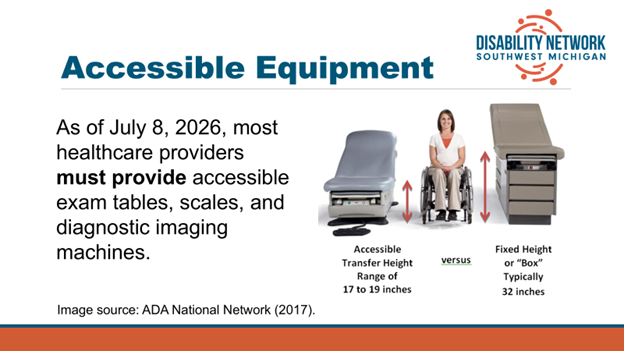
[Image description: Infographic titled “Accessible Equipment” says, “As of July 8, 2026, most healthcare providers must provide accessible exam tables, scales, and diagnostic imaging machines.” A pale-skinned woman sits in a wheelchair between two medical exam tables, only one of which is accessible. Arrows next to each table illustrate the height difference. Text beneath the exam tables reads, "Accessible transfer height range of 17 to 19 inches versus fixed height or 'box' typically 32 inches." Disability Network Southwest Michigan blue and orange logo in upper right corner of the image.
Community Conversation
Please join us for one of two virtual community conversations facilitated by Disability Network Southwest Michigan, offering the opportunity to connect with others taking the challenge and gain deeper learning from experts in the field.
Register today:
_________________________________________________________________________________________
Healthcare Inequality
Content Note: This topic and some of its associated resources mention medical discrimination that results in disability and death, involuntary institutionalization, abuse and neglect, forced treatment, physical restraint, self-harm, racism, and ableism.
Disabled people experience significant health disparities compared to their non-disabled peers. According to the National Council on Disability , in the United States, people with physical, intellectual, and developmental disabilities are more likely to have unmet healthcare needs and shorter life expectancies than those without disabilities. They are also 11 times more likely to die from pregnancy and birth-related complications.
Disabled people face a wide range of barriers when accessing the healthcare system. Often, they are not prioritized or taken seriously by the healthcare system and its providers. Consider these common healthcare scenarios:
- As of July 8, 2026, most healthcare providers are legally required to have accessible medical and diagnostic equipment, like exam tables, scales, and diagnostic imaging machines. However, not all healthcare providers follow the new rules, so disabled people may not receive important medical care or may be forced to travel great distances for treatment due to inaccessibility.
- During the COVID-19 pandemic, some states and healthcare facilities had policies of prioritizing critical resources based on disability. Many people with disabilities were pushed to the back of the line, causing higher risks of lifelong complications or death from COVID-19.
- Many physicians are reluctant or underprepared to treat patients with disabilities. A 2022 peer-reviewed study found that less than 60% of physicians fully “welcome disabled patients into their practices,” and only 40% feel “very confident” in their ability to treat disabled patients.
- People who rely on medications such as opioids, stimulants, and benzodiazepines to manage their disabilities often face unwarranted suspicion that they are seeking drugs for recreational purposes or illegally selling drugs.
- People with psychiatric diagnoses often face disbelief from medical professionals who misattribute their physical health symptoms to their mental health disabilities, which may lead to serious medical problems being overlooked: One study showed that people with psychiatric diagnoses are more likely to die within 15 days of release from an ER visit than other people.
- Individuals with chronic illnesses often wait years for a physician to listen to their concerns and seriously pursue diagnostic testing, and even longer to receive an accurate diagnosis.
- People with disabilities may receive inadequate sexual and reproductive healthcare because medical professionals assume they are not sexually active or do not want to have children.
- Deaf or hard of hearing people often struggle to find a healthcare provider who will pay for sign language interpretation. Doctors sometimes expect Deaf people to bring a friend, family member, or even child with them to interpret, but this does not afford them their right to medical privacy, independence, or access.
- Many people with fragrance-reactive disabilities lack access to healthcare facilities because the fragranced cleaning products used in building maintenance can trigger seizures, migraines, and anaphylaxis.
- In many states, Medicaid provides home and community-based services (HCBS) to disabled residents so they can live independently in the community rather than being forced into institutions, such as residential nursing facilities and psychiatric hospitals. Unfortunately, the level of care varies dramatically from state to state. If a person who receives 24/7 care from direct support staff in one state moves to another state with less funding for HCBS, they could end up institutionalized. Additionally, Medicaid often pays these direct support workers extremely low wages, resulting in a staffing shortage.
Action is urgently needed to address healthcare inequities. Providers must receive improved training to better understand and effectively meet the needs of disabled patients. It is essential for medical facilities to take proactive steps to enhance accessibility, ensuring that their equipment and services are welcoming, practical, and usable for everyone. Together, we can create a healthcare system that truly serves all individuals, regardless of their abilities. Let's build a more equitable and just healthcare system for everyone.
Take Action:
Each of us can contribute to improving healthcare equity for disabled people. We can contact our state and federal legislators to advocate for universal healthcare and comprehensive home and community-based services. Locally, we can start by asking our healthcare providers how patients with disabilities request accommodations, ensuring clear policies are in place. When visiting a provider’s office, we can also choose to avoid wearing scented products to help create a more accessible environment.
For those who work in healthcare, impact can be even greater. By completing disability competency training, transitioning to fragrance-free cleaning products, creating sensory-friendly exam rooms, and ensuring compliance with updated Section 504 accessibility requirements , healthcare workers can help make their practices models of disability-inclusive care.
Comments (0)
Popular

Dive in