
equity
October 29, 2026
Day 21: Resources
# Equity
# Disability
21-Day Disability Equity Challenge
Today's Challenge Topic: Resources
Thank you for participating in the 21-Day Disability Equity Challenge. We hope that the information we have shared over the past month has helped you to see disability through a lens of equity, social justice, and pride.
We know that this has been a lot of information, and we hope some of it has introduced a new way of thinking for you. The 21-Day Disability Equity Challenge will remain posted on the United Way's Community Connect platform . Feel free to revisit topics that interest you or that you might have missed. We encourage you to share and use what you have learned to promote disability justice throughout your spheres of influence.
More Resources:
Below are some local, state, and general resources on disability justice and advocacy, that you may find helpful. If you have questions about the information in this 21-Day Challenge, please contact Disability Network Southwest Michigan .
Local Resources:
- Centers for Independent Living (CILs) are consumer-controlled, community-based nonprofit organizations that provide information and referrals, advocacy, peer support, independent living skills, training, and transition services for people with disabilities. Most CILs in Michigan use the name Disability Network. Find your local CIL .
- Disability Rights Michigan is the independent, private, nonprofit, nonpartisan protection and advocacy organization authorized by Federal and State law to advocate and protect the legal rights of people with disabilities in Michigan.
- Michigan Advocates to End Seclusion and Restraint are fighting to end the use of seclusion and restraint on students in Michigan schools.
- Michigan Alliance for Families provides information, support, and education for families of children and young adults (birth to 26 years of age) who receive (or may be eligible for) special education services.
- Michigan Autistic Adult Advisory Committee (MiA3) is a statewide self-advocacy group of Autistic adults and an affiliate of the Autistic Self Advocacy Network. MiA3 advocates for Autistic perspectives in Michigan autism policy.
- Michigan Developmental Disabilities Council (MiDDC) works to change systems to serve the needs, wants, and desires of people with developmental disabilities.
- Michigan Disability Rights Coalition (MDRC) cultivates disability pride and strengthens the disability movement by recognizing disability as a natural and beautiful part of human diversity while collaborating to dismantle all forms of oppression.
- Michigan United Cerebral Palsy (MI-UCP) empowers Michiganders with disabilities statewide.
- Self-Advocates of Michigan (SAM) is a statewide advocacy organization led by and for people with developmental disabilities.
- Special Education Mediation Services (SEMS) provides support to students, parents and guardians in resolving disagreements, managing complex meetings, and improving communication between the school system and families.
- The Arc promotes and protects the human rights of people with intellectual and developmental disabilities and actively supports full inclusion and participation in the community. Find your local Arc chapter .
General Resources:
- Alliance Against Seclusion and Restraint works to eliminate the use of punitive discipline and outdated behavioral management approaches and end the school-to-prison pipeline.
- Americans with Disabilities Act (ADA) is landmark disability rights legislation. This federal government website provides information and technical assistance around the ADA.
- Autistic Self Advocacy Network (ASAN) serves as a national grassroots disability rights organization for the autistic community, advocating for systems change and ensuring that the voices of autistic people are heard in policy debates and the halls of power.
- Charting the LifeCourse (CtLC) is a framework that provides tools designed to help visualize ideas, vision, and goals, as well as problem-solve and advocate for supports.
- Collaborative & Proactive Solutions is an evidence-based, trauma-informed model of care developed by Dr. Ross Greene of Lives in the Balance that helps caregivers identify the problems that cause concerning behaviors in kids and solve them collaboratively and proactively.
- CommunicationFIRST protects and advances the rights, autonomy, opportunity, and dignity of people with speech-related disabilities through public engagement, policy and practice change, and systemic advocacy.
- Disability is Natural is a source for new ways of thinking about disability and moving beyond the status quo.
- Disability Visibility Project (DVP) is an online community dedicated to creating, sharing, and amplifying disability media and culture.
- International Association for Spelling as Communication (I-ASC) advances communication access for nonspeaking individuals globally through training, education, advocacy, and research.
- Job Accommodation Network (JAN) is a one-stop website for information on accommodations at work and advocating for disability rights in the workplace.
- National Association of the Deaf (NAD) is the nation’s premier civil rights organization of, by, and for deaf and hard-of-hearing individuals in the United States of America.
- National Council on Independent Living (NCIL) is the longest-running national cross-disability, grassroots organization run by and for people with disabilities.
- National Federation of the Blind (NFB) is the oldest and largest nationwide organization of blind Americans. The NFB works toward full integration, equality, independence, acceptance, and respect for all blind Americans.
- Project LETS is a national grassroots organization and movement led by and for people with lived experience of mental illness/madness, disability, trauma, and neurodivergence to create transformative peer support collectives and community mental health care structures.
- RAINN is the nation's largest anti-sexual violence organization. RAINN runs the National Sexual Assault Hotline in partnership with more than 1,000 local sexual assault service providers across the country.
- Rooted in Rights tells authentic, accessible stories to challenge stigma and redefine narratives around disability.
- Self Advocacy Resource and Assistance Technical Center (SARTAC) is a one-stop resource for organizing and supporting self-advocacy groups. SARTAC also provides free training and webinars to learn how to produce accessible information for print and the web.
- Self Advocates Becoming Empowered (SABE) is the United States’ national self-advocacy organization.
- Sins Invalid promotes leadership opportunities for people with disabilities within both our communities and the broader social justice movement.
- Therapist Neurodiversity Collective is a neurodiversity-affirming international therapy, education, and advocacy collaborative that advocates for radical changes in therapy practices to champion the human rights and dignity of disabled people.
- Thinking Person’s Guide to Autism (TPGA) is a resource that dispels autism myths and misinformation through evidence-based, neurodiversity-steeped information from autistic people, parents, and autism professionals.
Discussion:
- What are you taking away from the 21-Day Disability Equity Challenge?
- What more are you hoping to learn?
- What changes are you committing to make in your own life based on the information you learned in the 21-Day Disability Equity Challenge?
- Are there other people or organizations you can work with to make greater changes across your spheres of influence?
Image:
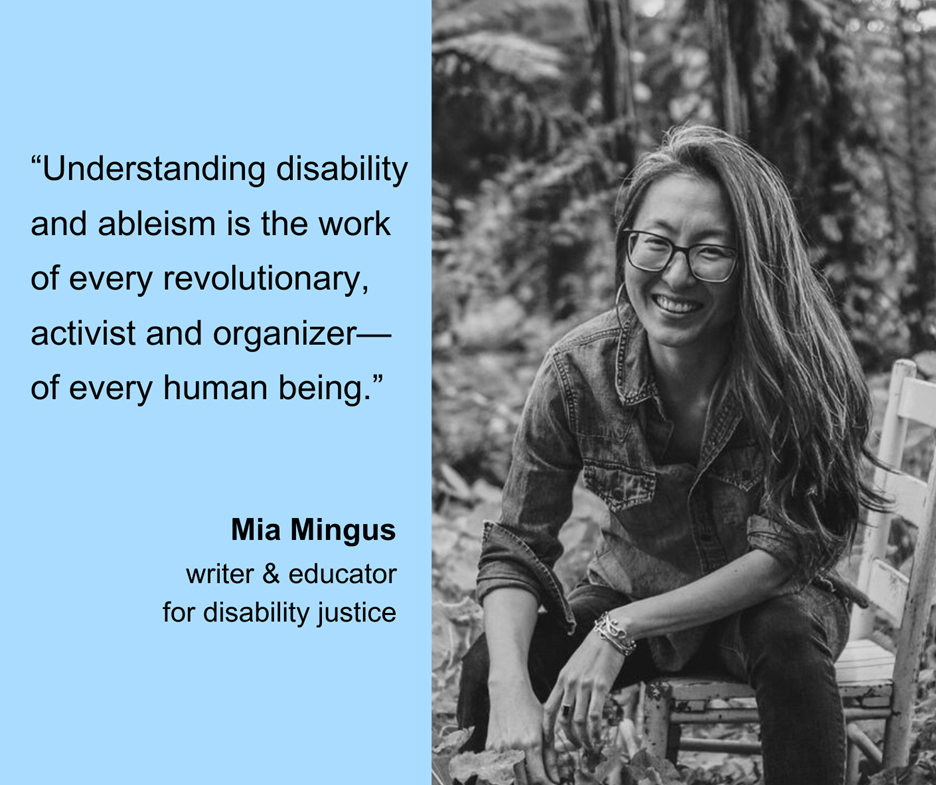
[Image description: A black-and-white photo of Mia Mingus, a Korean woman smiling with long hair and glasses, sitting on a wooden chair with plants and trees all around her. To the left, on a light blue background, is a quote from Mia Mingus, writer and educator for disability justice, that says, “Understanding disability and ableism is the work of every revolutionary, activist and organizer—of every human being.”
Comments (3)
Popular

Dive in